Approach
Our commitments
What every engagement gets
These hold whether the deal is $1 million or $20 billion.
Team
No juniors. No mid-levels.
With millions or billions at play there is no time for junior mistakes, and no sense in senior consultants spending their time supervising. A typical project fields three to six of them, depending on scope. Every reviewer is in the second half of a long technical career: multiple-time CTOs, chief architects, tech CEOs, VPs of engineering and security leads.
Evidence
The code is the ground truth
We work closely with the target’s engineers to understand what they built and which hard problems they actually solved. We read the code to guide the next question and to validate the answers we were given.
Judgment
We know what normal and good look like
We have worked on more than 500 deals across dozens of industries, so we know what normal looks like for a business of a given size, stage and market, and what good looks like. Every finding is weighed against that yardstick.
Findings
Insights you can act on
It is our job to tell you what matters and why, in plain non-technical language. If you or your engineers want to get technical, we will get technical.
Early Warning
Early escalation is in our DNA
Material findings do not wait. We raise our hands when we smell smoke, not when you see fire.
Deep Toolbox
Tools are input, not output
We use a broad range of tools and scanners, then senior engineers investigate the hot spots and form their own opinions. Automated graders over- and under-shoot, and a grade is not an answer. The report you receive reflects the combined judgment of the team that reviewed the code.
Strengths
Upside is a finding too
A clean architecture or a team that knows its trade-offs matters as much as a flaw does. Every report covers everything we find, good and bad.
How pricing works
Flexible scope. Fixed fee.
Surface area, scope, and depth work together to shape the engagement.
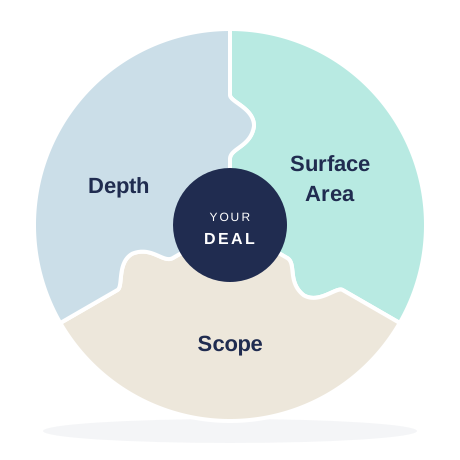
Surface area
The products, platforms, codebases, and teams behind the business.
Scope
The assessment areas that matter to your deal thesis.
Depth
How far we investigate, shaped by deal stage, timeline, and access.
As findings emerge, we align with you on where to focus the remaining effort.
Early findings help us direct the agreed effort toward the risks and opportunities that matter most.
Typical project timeline
Three weeks
Week 1
With the Team
Deep dive into the target architecture in a concise working session. AI, ML and LLM deep dive if in scope.
With you
Tech DNA is introduced to the target and receives source code.
Week 2
With the team
Follow-up architecture and scalability session. Privacy deep dive if in scope.
With you
Interim report out and aligning effort
Week 3
With the team
Final follow-up session. Trailing questions, if any, which happens about ten percent of the time.
With you
Final report out, tailored to the audience.
We've done projects spanning 2 days to 2 years. Tell us what your timeline is.
What we ask of the target
Designed to stay light on their engineers
Architecture Intro
One architecture walkthrough to start. We come prepared, so the target does not build a deck for us.
~6 hrs / week
Tapering as the engagement progresses.
Daily, in writing
Short, tailored written question rounds their team answers asynchronously, on their schedule.
Zero homework
No documents or diagrams created just for us. The code answers most questions before anyone has to.
Source code
Why we ask for the code, and how we protect it
Why code
The code is the ground truth
Reading the code validates the answers we are given and lowers the burden on the target. A question answered by the repository is a question their engineers never have to sit through on a screenshare. It is also the difference between an opinion and a finding.
Never shared, not even with you
The code is read by the assigned project team and no one else. The client receives findings, not code. That boundary is what makes us palatable to targets, and protects you from taint.
Safe custodian, nothing retained
Read-only access, inside the target’s security envelope or our own. When the engagement ends, access ends and nothing is kept. We have been the custodian of hundreds of code bases on deals from $1M to $20B+.
Report-outs
Same findings, tailored to the room
Deal sponsors
The broadest readout: the tech, the business implications, integration, roadmap, and what happens near, medium and long term.
Transaction partner team
The key messages straight from the evaluators without explaining things they already know.
Absorbing tech team
Our assessment of the technology and what it means for the deal.
C-suite and board
Business-only audiences: all of the “so what” in plain English, without the techno jargon.
Legal team
The findings that overlap legal diligence: open-source licensing, privacy compliance, data handling, jurisdictional reach, data provenance and evidence of patent claims in code.
Ready to scope